Sourcing fees and supplier quotations are easier to compare when service tasks, product price, pass-through costs, commissions, and change terms are separated. Importers should request itemized scope, clear payment triggers, comparable supplier assumptions, and written decision rights before appointing a provider or releasing an order.
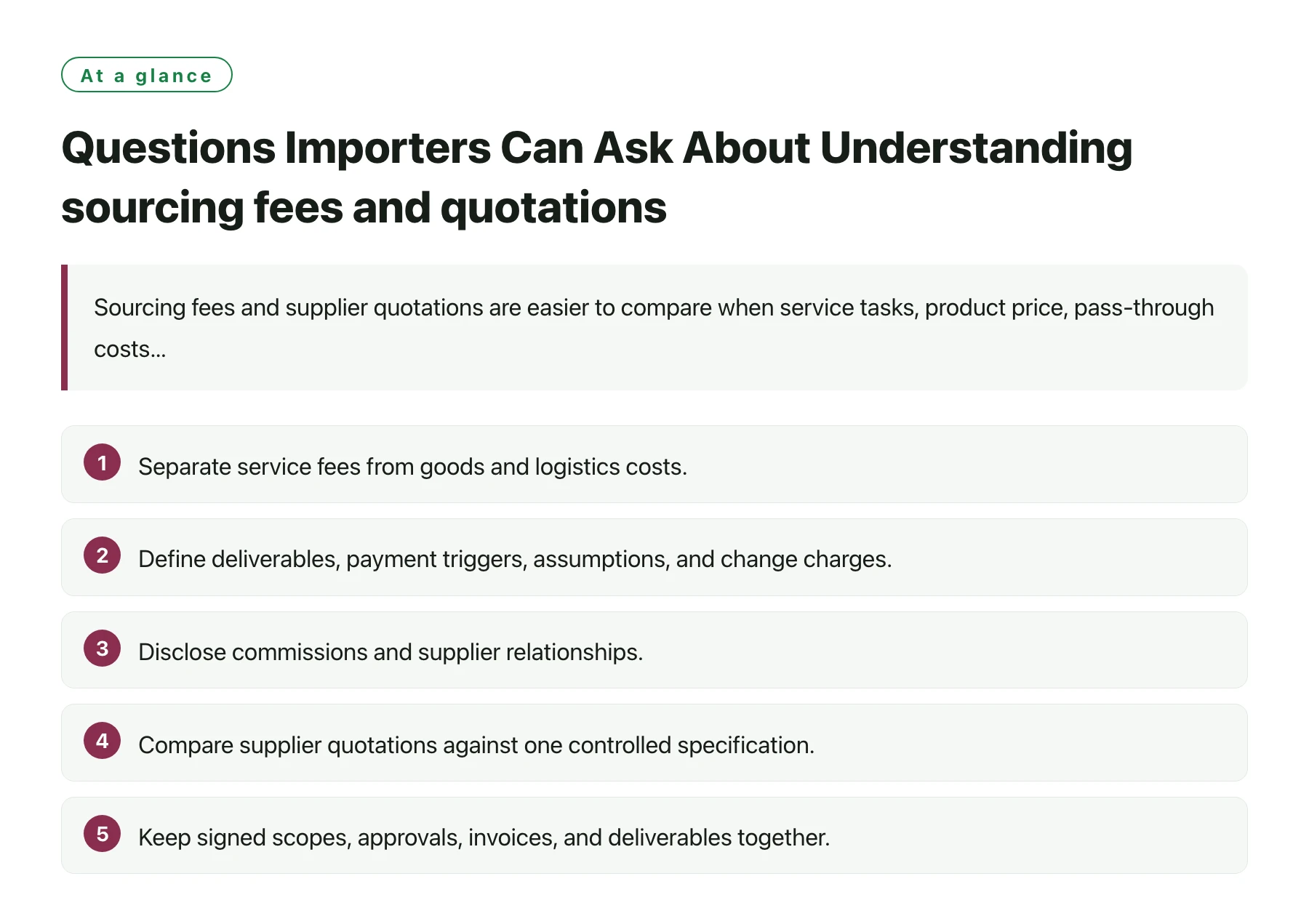
Key takeawaysSeparate service fees from goods and logistics costs. · Define deliverables, payment triggers, assumptions, and change charges. · Disclose commissions and supplier relationships. · Compare supplier quotations against one controlled specification. · Keep signed scopes, approvals, invoices, and deliverables together.
Two offers can quote different work even when both use the same label. These questions help buyers expose that difference before committing budget or product orders.
Ask what work the quoted fee covers
Start by separating the service fee from the goods price and logistics costs. Ask for a task list: market research, supplier identification, capability checks, request-for-quotation coordination, sample handling, negotiation, production communication, inspection arrangement, document collection, or freight coordination. A phrase such as full service is too broad to compare without named deliverables.
For each task, ask who performs it, when it is due, what evidence you receive, and how revisions are handled. A supplier shortlist might state inclusion criteria and verification limits; a sample service might list model, date, photographs, and unresolved points. Define exclusions such as laboratory testing, travel, translation of technical files, customs brokerage, or third-party inspection.
Procurement covers a wider cycle than purchasing alone, including activities such as market analysis, sourcing, negotiation, contracting, and supplier relationships. CIPS describes these stages as part of procurement work.[1] Ask whether a proposal supports one step or multiple stages and where your own team must take over.
Understand the fee structure and payment triggers
A provider may quote a fixed project fee, recurring retainer, hourly rate, milestone fee, commission, percentage of order value, or a combination. Ask how the fee is calculated, what event triggers each invoice, what currency and payment method apply, and whether unused hours or cancelled work are refundable. Confirm who pays bank charges and taxes where relevant.
For a percentage fee, request the base amount in writing: product value, freight, tax, tooling, or some other defined total. Clarify how the percentage changes when quantities or order revisions change. For hourly work, agree on rate bands, time records, approval before overtime, and a spending cap. For a fixed price, identify assumptions and change-order rates.
List pass-through costs separately. These can include samples, courier fees, factory visits, inspection providers, testing, translation, warehousing, or domestic transport. Ask whether receipts or third-party invoices will be provided and whether the provider adds a handling charge. Do not compare one all-in number with another quote that excludes these costs.
Check incentives, commissions, and supplier relationships
Ask whether the provider receives money, gifts, rebates, or other benefits from suppliers, factories, logistics companies, or inspection firms. Request written disclosure of commissions and related-party relationships. If a provider says the service is buyer-paid, clarify whether that statement applies to all work and all supplier referrals.
Understand how the provider selects suppliers and how recommendations are separated from commercial incentives. Ask whether multiple qualified options will be shown, whether an alternative can be considered, and what criteria support a recommendation. The answer should make the provider’s role and the buyer’s final decision authority clear.
Confirm who contracts with the factory and owns the commercial relationship, payment, quality claims, and order records. If funds pass through an intermediary, ask how they are safeguarded, reconciled, and documented. Have your finance or legal adviser review arrangements involving deposits, agency roles, or payment on your behalf.
Make supplier quotations comparable
Send each supplier the same dated specification, quantity, options, packaging assumptions, delivery term, and destination. Ask for line-item pricing and written exceptions. A quote should identify model or product code, included parts, tooling, sample charges, minimum order quantity, production lead time, payment milestones, quote validity, warranty terms, and what happens when an approved change affects price or schedule.
Separate product price from shipping estimates, duties, destination charges, inspection, labeling, and other services. Request the currency, unit basis, carton quantity, and whether the price is ex-works, FOB, or another named delivery term. Ask the freight provider or broker to verify landed-cost assumptions for the actual route and import destination.
Create a comparison with columns for requirement, supplier response, quoted amount, included scope, assumption, deviation, and open question. Do not choose on unit price until specification compliance and total commercial scope have been reviewed. Mark estimates clearly; a freight or duty estimate is not a final charge until the responsible party confirms it.
Agree on changes, cancellations, and records
Ask how changes to quantity, product design, material, sample, delivery address, or production schedule will be priced and approved. A change request should state the fee impact, supplier cost, timing effect, and decision deadline. Identify whether work may continue while approval is pending and who bears the cost if the buyer declines.
Define cancellation terms and what happens to completed work, purchased materials, tooling, samples, and deposits. Include treatment of partially completed milestones and third-party costs already incurred. Ask how disputes are escalated and which contract terms govern if emails, proposals, and purchase orders conflict.
Keep the signed scope, quotation, supplier offer, fee schedule, approved changes, invoices, and deliverables in one project record. Reconcile each invoice against its milestone and approved expenses. This record makes it easier for procurement and finance to understand the actual cost of the service and goods.
Use focused questions before appointing a provider
Before signing, ask: What exactly will you deliver? Who performs each task? How are suppliers screened? How are commissions disclosed? Which costs are excluded? What triggers payment? What requires buyer approval? Who owns supplier communication and records? What happens when the specification or schedule changes? How can the engagement end? Request clear written answers rather than relying on a verbal overview.
For JS Sourcing sourcing support in China, importers can request a proposal that maps the service fee to supplier research, quote comparison, sample follow-up, production communication, and inspection coordination as relevant. Define the buyer’s approval rights and decision owners, and have commercial and compliance specialists review commitments that fall outside routine coordination.
Sources
Frequently asked questions
Should a sourcing service fee be compared with the supplier’s unit price?
Compare them separately first, then calculate the full project cost using consistent product quantities, logistics assumptions, service scope, and disclosed pass-through charges.
What is a pass-through cost?
It is a third-party expense billed through the provider, such as courier, testing, travel, or inspection. Ask whether receipts and handling charges are included.
Why ask about commissions?
A commission or supplier benefit can affect incentives. Written disclosure helps the buyer understand relationships and how supplier recommendations are made.
What should happen when a project change affects the fee?
The provider should document the scope, price, schedule, and third-party cost effect and receive the required buyer approval before proceeding.